
Why drinking feels harder to control in the evenings · Part 1
Why Do I Want Wine at 5pm?
Understanding decision fatigue and alcohol cravings
By Rina Bowring
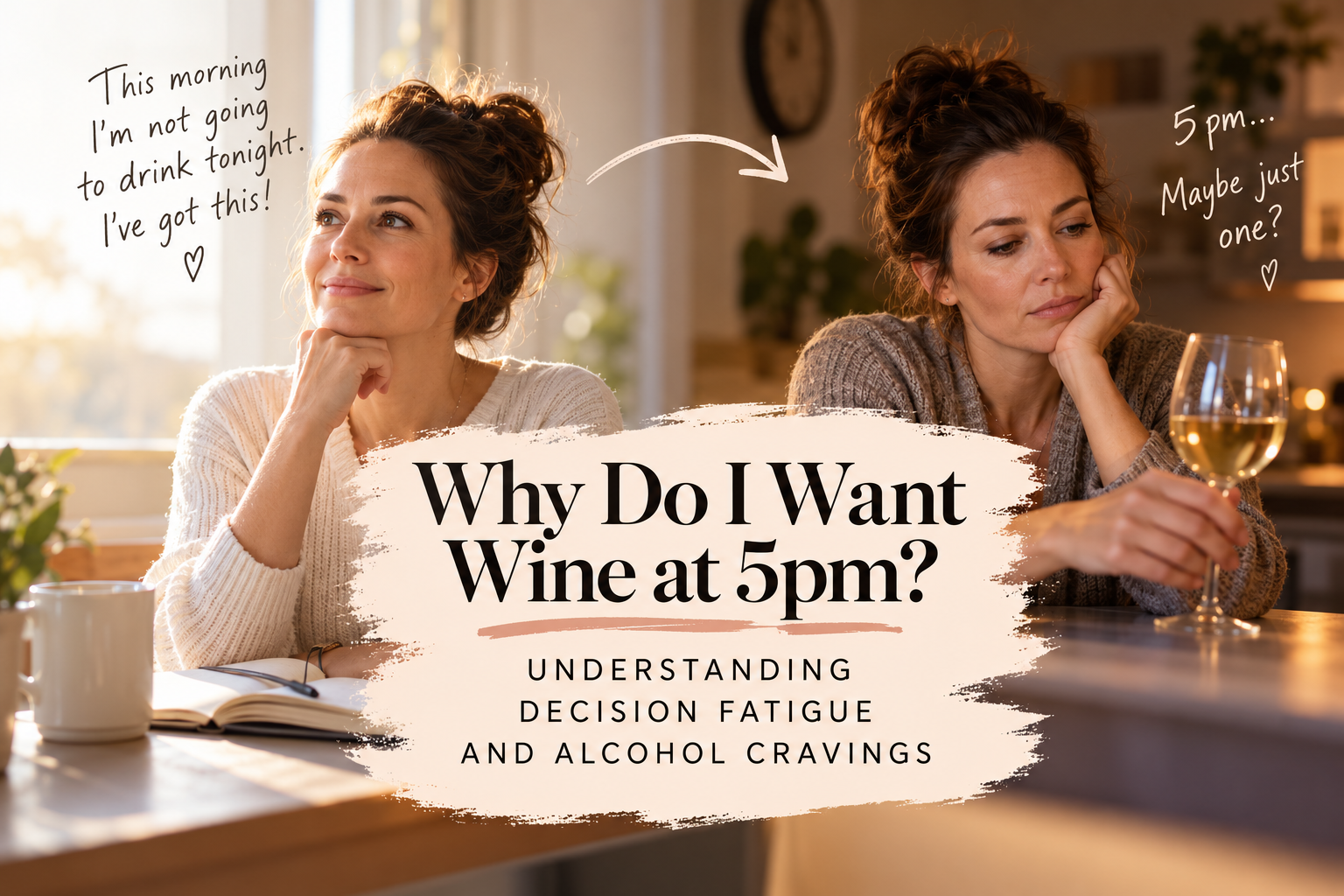
Have you ever noticed how you can wake up in the morning feeling so clear and determined that you're not going to drink that evening, yet by 5pm you find yourself with a glass of wine in hand?
Perhaps you've even wondered, What's wrong with me? Why can't I just stick to my decision?
Well, friend, one of the things that may be contributing to this pattern is something called decision fatigue.
And understanding it can really help us begin to understand ourselves differently and plan differently.
What Is Decision Fatigue?
Think about how many decisions you make in a normal day.
From the moment you wake up, you're making choices.
What to wear. What to make for breakfast. What the kids need. What needs to get done at work. How to respond to that difficult email. What to make for dinner.
And then, on top of all of that, there's another decision running in the background all day.
Am I drinking tonight?
No, I'm not.
Maybe just one?
No, I said I wasn't going to.
It's exhausting, isn't it?
Decision fatigue describes the mental exhaustion we can experience after spending so much of our day making choices, solving problems and managing competing demands.
When we're mentally tired, it can become harder to think things through carefully.
And our familiar, automatic habits can start to feel particularly appealing.
Why Do Alcohol Cravings Often Feel Stronger at 5pm?
If you've spent years reaching for a glass of wine at the end of a busy day, that's a very familiar pathway for your brain.
It's something you've practised over and over again.
So by 5pm, when you're tired, hungry and overwhelmed, your brain offers you what it knows.
How about a glass of wine?
And here's something I really want you to understand.
The morning version of you meant every word.
You genuinely wanted to do something different.
But perhaps you hadn't accounted for just how different your mental and physical state would be by the evening.
This isn't necessarily about a lack of motivation or commitment.
It's about recognising that your capacity to make thoughtful decisions can feel very different when you're mentally and physically exhausted.
And that's something we can begin to work with.
How Can You Reduce Decision Fatigue and Make Alcohol-Free Evenings Easier?
Rather than relying on our tired, overwhelmed evening selves to make all the decisions, we can make some of those decisions earlier in the day.
Here are three simple ways to begin.
1. Plan Dinner Before the Evening Arrives
If cooking dinner is a big drinking trigger for you, perhaps you could decide what you're going to cook in the morning.
Maybe even prepare something ahead of time.
Or perhaps you could choose simpler meals for the time being.
Remember, we're trying to reduce the number of decisions we need to make when we're at our most vulnerable.
2. Create a Plan for Your Usual Drinking Trigger
If you know you usually start thinking about wine the moment you walk through the front door, perhaps you could decide beforehand what you're going to do instead.
Maybe you'll make yourself a lovely alcohol-free drink, change into comfortable clothes and spend five minutes outside.
Nothing complicated.
Just a simple plan that gives your brain another familiar option to practise.
3. Make One Clear Decision Ahead of Time
If you find yourself negotiating with alcohol every single evening, perhaps you could experiment with making one clear decision ahead of time, one day at a time.
Tonight, I'm not drinking.
And when the thought comes up later, you can gently remind yourself:
I don't need to reopen that decision. I already have a plan.
Now, this doesn't mean the craving or thought will magically disappear.
But it can help us avoid getting caught in that exhausting mental tug-of-war.
Of course, if you may be physically dependent on alcohol, it's important to seek medical advice before reducing or stopping your drinking.
Small Changes Can Make a Meaningful Difference
I want to encourage you to keep this really simple.
We're not trying to overhaul our entire lives overnight.
We're learning to work with our brains and bodies rather than constantly fighting against them.
And sometimes making one small decision earlier in the day can make a really meaningful difference later on.
One small step at a time, my friend.
✏️ Reflection Invitation
I'd love to invite you to spend a little time reflecting on your own evenings.
Where am I making lots of decisions when I'm already tired?
What could I decide or prepare earlier in the day to make my evenings a little easier?
What's one small decision I could take off my evening plate?
You don't need to change everything.
Just choose one small thing you could do differently today.
A Quick but Important Note 🤍
This article is general educational and coaching content only. It is not medical or psychological advice or a substitute for professional care.
If you may be physically dependent on alcohol, please don't stop or significantly reduce your drinking without first speaking to your doctor or another qualified health professional. Alcohol withdrawal can be dangerous or life-threatening and may require medical supervision.
Your safety always comes first.
Ready to Stop the Mental Tug-of-War With Alcohol? 🤍
If you recognise yourself in this cycle — waking up determined not to drink, only to find yourself negotiating with alcohol again by 5pm — I want you to know that change is possible.
And you don't have to keep relying on willpower to get there.
That's exactly why I created Fixated to Free.
A 100-day, faith-centred and neuroscience-informed coaching journey designed to help Christian women understand their drinking patterns, renew their thinking, and begin building the foundations for lasting alcohol freedom.
Together, we'll explore what's keeping you stuck, learn practical tools to navigate cravings and difficult emotions, and begin practising new ways of responding — all grounded in God's grace.
Because freedom isn't just about learning how to say no to alcohol.
It's about changing the way you think about alcohol, yourself and what's possible for your future.
🤍 Our next Fixated to Free journey begins 12 December 2026!
If you're ready to move from feeling defeated by your drinking to feeling hopeful, grounded in grace and confident in your ability to change, I'd love to invite you to join us.
Explore Fixated to Free and join the waitlist