
Why drinking feels harder to control in the evenings · Part 2
A Better Alcohol-Free Evening Starts Before 5pm
Part 2: The 50% Battery Rule — a simple way to manage evening alcohol cravings before you're running on empty.
By Rina Bowring ·
Missed Part 1? Read Part 1: Why Do I Want Wine at 5pm?
Have you ever noticed how you can start your morning feeling so determined not to drink that evening, but by 5pm, all you want is a glass of wine?
Well, here's something I've been learning.
A good evening doesn't actually start at 5pm. It starts much earlier in the day.
And this can be such an important shift when we're trying to change our relationship with alcohol.
In Part 1 of this series, we explored why evenings can feel so difficult. We looked at decision fatigue, tiredness, hunger, and how our brains can fall back on familiar habits when we're feeling depleted.
Today, I want to share a really simple practice that can help us become more intentional about how we arrive at the end of our day.
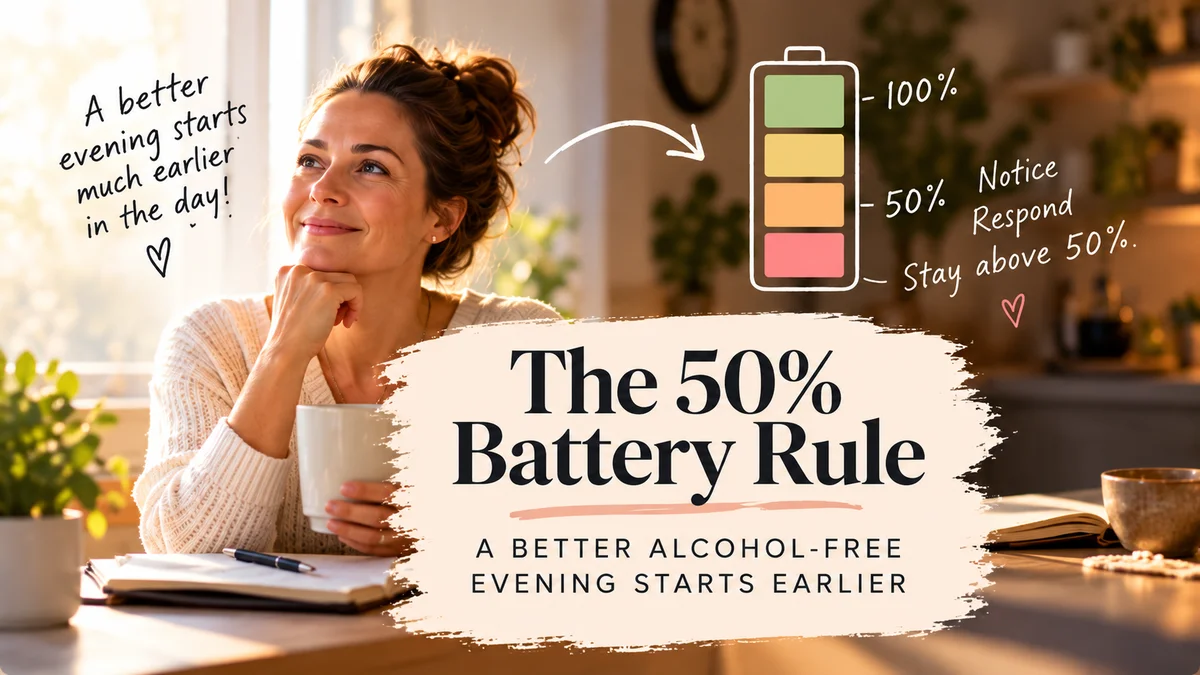
It's called staying above 50%.
Why Evening Alcohol Cravings Can Feel So Strong
I want you to imagine that your energy is like the battery on your phone.
You wake up in the morning, hopefully with a reasonably full battery.
And then your day begins.
Getting the kids ready. Work. Emails. Decisions. Conversations. Responsibilities. Meeting everybody else's needs.
And slowly, throughout the day, that battery starts to drain.
But here's the thing.
Most of us are so busy getting through our days, looking after everyone else, and doing all the things that need to get done that we don't actually stop to notice how we're doing.
We just keep going.
And going.
Until suddenly it's 5pm.
We're overstimulated, overwhelmed, exhausted, irritable, and all we want is something to make us feel better.
And for many of us, of course, that something has been alcohol.
Or perhaps you've already put alcohol aside, but now you're finding yourself scrolling endlessly on your phone, reaching for snacks, or turning to some other familiar habit that offers a little comfort or relief.
And this makes sense, doesn't it?
When we're tired, stressed, and overwhelmed, those familiar behaviours that promise quick comfort can become especially appealing.
And when we're trying to change an established drinking habit, that can make things feel so much harder.
So rather than waiting until we're completely depleted at the end of the day, what if we started paying attention much earlier?
What Is the 50% Battery Rule?
Imagine your energy on a scale from 0 to 100%.
At 100%, you're feeling rested, calm, clear, content, and able to manage what the day brings.
At 50%, you might begin noticing that you're a little tired, less patient, perhaps overwhelmed, or that ordinary things are feeling harder than usual.
Below 50%, you might become increasingly irritable, stressed, exhausted, or desperate for a break.
Now, of course, these aren't actual scientific measurements!
It's simply a way of becoming more aware of how we're doing.
And the goal isn't to feel wonderful all day long. That's just not realistic.
The goal is to notice when our resources are running low, before we're running on empty.
Because when we're depleted, it can become much harder to pause, think clearly, and choose how we want to respond.
And when we're rethinking and reworking our relationship with alcohol, we're already practising something that requires a lot of intention and awareness.
So why not make that a little easier for ourselves?
A Simple Daily Practice to Help Prevent Evening Drinking Triggers
Here's what I'd love to invite you to experiment with this week.
Set a little reminder on your phone, perhaps three to five times throughout the day.
And when it goes off, pause for a moment and ask yourself three questions.
1. Where is my battery right now?
If you had to give your energy a percentage, what would it be?
80%? 60%? 40%?
Just notice.
2. How am I actually feeling?
Am I tired? Hungry? Anxious? Overwhelmed? Frustrated?
Or perhaps I'm feeling quite good! Energetic, hopeful, content.
Again, we're simply noticing.
No judgement. No need to fix anything immediately.
3. What would nourish or revive me right now?
Oh, I think this is such an important question.
Because so often we're so focused on what everybody else needs that we forget to consider what we need.
And I'm not talking about adding another complicated routine to your already busy day.
I'm talking about noticing whether there's one small thing you could do to look after yourself before your battery drains any further.
Three Ways to Recharge: Rest, Restructure or Reprioritise
When you notice yourself approaching that 50% mark, rather than automatically pushing through, consider whether you need to rest, restructure, or reprioritise.
Rest
Perhaps you're simply tired.
Could you sit down for ten minutes with a cup of tea?
Take a few deep breaths?
Spend a moment in quiet prayer?
Sometimes the most helpful thing we can do is stop.
And yet, how often do we convince ourselves that we can't rest until everything is done?
Restructure
Perhaps you need to change the order of your afternoon.
Instead of going straight from work into cooking dinner and managing everybody else's needs, could you build in a little transition time?
Go for a walk?
Sit outside for ten minutes?
Make yourself a lovely alcohol-free drink and enjoy it before starting dinner?
Sometimes changing the order of things can make such a difference.
Reprioritise
And perhaps you simply need to let something go.
Maybe the house doesn't need to be perfectly tidy tonight.
Maybe dinner can be toasted cheese sandwiches.
Maybe that email can wait until tomorrow.
Now, I know this can be difficult, especially if you're someone who's used to being productive, getting everything done, and looking after everybody else.
I know that tendency very well myself!
But here's something I'm learning.
When I'm running on empty, the people I love don't necessarily get the version of me I want to offer them.
They get the irritable me. The impatient me. Sometimes even the resentful me.
Not the generous, loving, patient version.
And so perhaps recognising our limits and responding to them isn't selfish at all.
Perhaps it's actually one of the ways we can love and serve others better.
How Does This Help You Stop Drinking in the Evenings?
If you've been in the habit of reaching for wine every evening, you might be focusing all your energy on that moment when the craving arrives.
Trying to resist it.
Trying to distract yourself.
Trying to talk yourself out of it.
And sometimes those strategies can be helpful.
But I want to encourage you to get curious about something else.
What happened in the hours leading up to that craving?
Had you eaten enough?
Were you exhausted?
Had you been pushing through all day without a break?
Were you feeling overwhelmed by everybody else's needs?
Was there something you needed that you hadn't allowed yourself to receive?
Because sometimes the desire for alcohol is tangled up with a very real desire for rest, relief, comfort, or simply a moment that belongs to us.
And although looking after those needs won't necessarily eliminate every alcohol craving, it can help us build a different relationship with our evenings.
One that's a little more intentional.
A little more nourishing.
And perhaps a whole lot more enjoyable.
Your Experiment This Week
So here's my invitation.
For the next seven days, check in with your battery throughout the day.
Notice when you're approaching 50%.
And ask yourself:
Do I need to rest, restructure, or reprioritise?
Then choose one small thing.
That's it.
And please remember, you cannot fail at this.
If you experiment with something and it doesn't go the way you'd hoped, that's simply an invitation to learn.
What did you notice?
What might you try differently next time?
Don't underestimate the value of small actions. Small actions, repeated over time, can lead to beautiful and lasting change.
And if faith is part of your journey, lean on the One who is the source of all wisdom and every good gift to guide you as you learn these new rhythms.
Be patient with yourself, my friend.
A good evening starts much earlier in the day.
And you're allowed to look after yourself along the way. ❤️
If you'd like support putting this into practice, you can explore my coaching options.
Frequently Asked Questions
Why do I crave wine at 5pm?
Evening alcohol cravings can be influenced by stress, fatigue, hunger, established habits, and the association between drinking and relaxation. For some people, alcohol withdrawal or physical dependence may also contribute. Understanding what happens throughout your day can help you identify your personal triggers.
How can I stop drinking alcohol every evening?
Start by getting curious about the role alcohol plays in your evening. Is it helping you unwind, transition out of work mode, or escape stress? Experiment with alternative routines and look for ways to meet those needs earlier in the day. If you're physically dependent on alcohol, seek medical advice before stopping abruptly, as withdrawal can be dangerous.
What is the 50% Battery Rule?
It's a simple self-awareness practice that encourages you to check your energy levels throughout the day and respond to signs of depletion before you're completely exhausted. The percentages are a metaphor, not a medical or scientific measurement.
What can I do instead of drinking wine after work?
Consider a short walk, a cup of tea, an alcohol-free drink, a snack, a moment of prayer, or ten minutes of quiet before beginning your evening responsibilities. Experiment with what genuinely helps you feel rested and restored.
Ready to Rebuild Your Evenings?
If you're ready to change your relationship with alcohol, I'd love to invite you into my free Alcohol Freedom Tribe community.
Inside, we explore practical, neuroscience-informed tools, gentle reflection, and small daily actions to help you move beyond simply trying not to drink and towards creating a life you genuinely love living.
Whether you're exploring mindful drinking, considering alcohol freedom, or already living alcohol-free, you're welcome.
Join the Free Alcohol Freedom TribeLearn more about the community on the Community page.
Rina Bowring is a certified This Naked Mind and Grey Area Drinking Coach, offering faith-inclusive, neuroscience-informed coaching to help people change their relationship with alcohol through curiosity, compassion, and grace.
Next in the series
Part 3 is coming soon. In the meantime, browse more resources